Archives

Passive or Active?

One of the best articles I read recently, regarded writing in a passive or active voice.

Since I’m in the process of a major edit, I’ve noticed that I frequently write passively. That’s something I’m changing, and I’m amazed at the difference in the way my book reads.

Even though I’m writing in third person, and I use the word ‘was’ frequently, it’s easy to fall into the trap of always using it, and it’s not necessary. Let me explain…

Here’s a simple sentence: He was alone. Okay…that works. Cut and dry. (very dry) But, it paints a picture in my mind, and it’s alright.

But here’s what you don’t want to do: He was  walking down the street going to the grocery store. (passive voice). To make this sentence active, change it to: He walked down the street to the grocery store.  See/hear the difference?

Of course, these are made up, sample sentences, and not something I would put in a book. If I did, my readers would be bored to tears!

One of the first sentences I ever wrote in a book was: She had grown up there, and it was all she’d ever known. Learning what I know now, that sentence became: She grew up there, and it was all she knew. (But, to tell you the truth, I have completely removed that sentence, because it was in an ‘introduction’ to my book which has been completely eliminated!)

Here is another simple example: He was standing in the doorway.

The simple change: He stood in the doorway.

It’s always good to read aloud what you’ve written. If it flows off your tongue naturally, that’s a good sign. If it jolts you, and doesn’t feel right, then it will most likely jolt your

readers and you will need to look closely at what jolted you and fix it. It’s important to get your thoughts on paper, (computer), but remember that it can always be changed. It sometimes helps to walk away from it for a while. I’m surprised at how many times I can go back to something I wrote, and after re-reading, see exactly how I need to fix it and make it better.

If you’ve ever written a sentence that makes you wince each time you read it, it feels really good when you come up with a way to say what you mean in an “unwincable” way. (Yes, I know…it’s not a word!)

WRITE ON!!

 

He looked out the window.

He looked out the window.


Silly words, Silly rules…

How important is it to have a “clean” manuscript when the time comes to submit to an agent or publisher? And by clean, I don’t mean “G-Rated.”

This kind of clean deals with punctuation, spelling, and grammar.

Coming from a writer who is on the edge of being published, I can tell you what I’ve learned. The cleaner, the better.

Yes, if you intend to publish traditionally, then you will have an editor who will go over your work with a fine-toothed comb, but I believe they appreciate effort on the writer’s part even before they see the manuscript. I know that if I was sitting in their position, I would be more inclined to read something clean, than something that had bothersome errors staring at me in every sentence.

Have you ever read a book and found typos? I know I have, and they tend to throw off my reading. I know that we’re all human, and it’s impossible to catch every typo, but give it your best. This definitely applies if you plan to self-publish. And if that’s something you plan to do, I would highly suggest you hire a professional editor to go over your work. The last thing you want to do is publish something that isn’t ready.

As for the rules of writing…they can change.

Years ago, (back in the days of typewriters), the rule for spaces after a period, was two spaces. Somewhere along the line, that changed. The rule is now, one space. This may seem trivial, but it makes a difference. It took me a while to get used to not hitting the space bar twice at the end of a sentence, but have now almost mastered it. I occasionally slip!

Which brings up something else. The word, (or words), awhile. I read a very good article about how to know when to use awhile, or a while. I’ve been using this little trick ever since: It will almost always be two words, unless you can replace the words in your sentence with “for a short time.”

So, if I were to write: I’m going out for a while, it would be two words, because it wouldn’t make sense to say: I’m going out for for a short time.  However, if you wanted to write: I’m going out awhile, (leaving out “for”), then it would work.  If you replace awhile  in this sentence with, for a short time, then it would read: I’m going out for a short time.  I hope that makes sense!!

I use Word 2010 for all of my writing, and I drive it crazy! I write dialog to fit my characters, and most of them do not speak proper English. So the automated “grammar and spell check” freaks out. I laughed the first time I saw the message, “this document contains too many grammatical/spelling errors to display.” I don’t think those are the exact words, but close.

If you have any fun little rules of writing that you would like to share, please do. I find that I’m constantly learning new things and would love your input.

No matter, what…keep on writing. The more you write, the better you will get.

WRITE ON!!!

I think I'll lay down awhile, or maybe sleep for a while.

I think I’ll lay down awhile, or maybe sleep for a while.

And where have I been?

The best made plans…

Last week, I told myself that I needed to be more faithful with my blogging. I jotted down a few notes of things I wanted to discuss, and then…

My husband had a heart attack on Friday night. Believe me, it’s something I hope to never have to go through again. He had open heart surgery seven years ago, but that was prompted by a bad EKG at a regular check-up, not a heart attack. I wouldn’t wish either of these scenarios on anyone, but believe me, the experience I had Friday night was terrifying. Luckily, we live only 15 minutes from a hospital, and I was able to get him there quickly. I opted to drive him myself, feeling I could get him there quicker than waiting for an ambulance. Maybe not a wise idea, but we live out in the country, and it seemed the smart thing to do at the time. Besides, he wasn’t completely convinced he was having a heart attack, but was hurting something fierce.

I’m happy to report that that he’s doing very well, thanks to the care of amazing doctors and nurses, and a successful emergency surgery.

This is one of those life experiences that I had witnessed on TV and movies, but having lived it now first-hand, I have a whole new perspective. My sister had a heart attack some time ago, and so guess who I turned to when I was in the ER, waiting, while they worked on my husband? Yes, my poor sister! I doubt she’ll ever forget the panic in my voice, or the little-to-no sense I was making in conversation. But, simply by hearing her voice, I was comforted. Thank you, Sis.

When he had his open heart surgery, I stayed by his side throughout his week’s stay at the hospital. At that time, I read “Harry Potter” while he slept. This hospital stay was only three days, (Yeah!), but I was glad I had my laptop. Rather than reading, I edited. I rested my mind by escaping to 1870-something, and caught myself up in the trials and tribulations of my fictitious family. At one point, I read to my husband, and promptly put him to sleep! He promised me that it wasn’t out of boredom. I believe him…

So now, you know where I’ve been! I still have my notes for the “writing” posts I intend to do, and will post them soon.  I pray that we’ll have smooth sailing for a while. Enough drama in our lives this past year to last a very LONG time.

Thanks for stopping by, and…

WRITE ON!!!

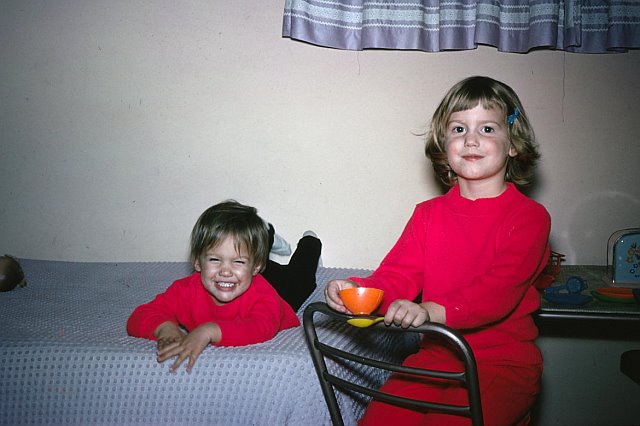
Me and my sister...Always  there for me, even way back then!

Me and my sister…Always there for me, even way back then!


Finding Your Voice

Every writer has a unique voice. As a reader, you should be able to hear the unique qualities of the book’s author  in your head.

Some authors write with a natural flair for humor. Others, have a more subtle approach. But it’s your voice as a writer that will cause a reader to keep reading. You may have the best plot in the world, but if you have a dull, monotone, completely uninteresting voice, your reader won’t get far enough into your book to see that you have a killer plot!

It was easier to understand “voice” when I was working as a singer. My voice was obvious. It boomed out into the lounge thanks to a great sound system. I’m happy to say that no one ever threw rotten vegetables at me. A good sign that my voice was appreciated. But, everyone has different taste in music, and not all people liked to hear me sing. I didn’t rap, (okay…I made an attempt at it once), and I wasn’t into heavy metal. Also, opera was, and is, something I’ll never attempt to sing. It’s not me. It’s not my voice.

When I first decided to sing, I had people ask me if I was going to take voice lessons. Should I have been insulted? No. Though I chose not to take voice lessons, I look back now and believe they could have helped me. I was afraid that they would take away my unique qualities and make me like everyone else. What I didn’t understand is that I could have learned techniques that would have enhanced my voice, not change it. Perhaps it was pride that kept me from taking that next step. Whatever the case may be, I know now that it never hurts to learn ways to improve your craft.

So, how does this influence me as a writer? Well…again, I have a unique writing voice. But what I’ve learned is that I’m not going to shy away from learning ways to improve my writing. When I first joined RWA and my local MCRW chapter, I had someone tell me that I needed to learn what everyone else in the group knew, so that I could be like everyone else. My thought was, ‘why would I want to be like everyone else?’

I understand now. Others in the group knew more than I did about the industry. They knew techniques to improve my writing. Sitting around me was a vast amount of knowledge in the minds of other writers who had no hesitation about sharing what they knew. All I had to do was listen and learn. Wow!

So, instead of being insulted believing that I was being told I was unable to write at that point, I jumped in and started soaking up knowledge. And, after nearly two years in the chapter, I’m still learning. And loving every minute of it!

My voice is still my voice, but now I’ve learned ways of putting it on paper that will make a reader want to keep turning the pages.

Keep your unique qualities, but don’t shy away from learning ways to improve them.

WRITE ON!!

Find your voice...

Find your voice…

Reconstruction

Since the South went through a difficult period of Reconstruction following the Civil War, then I “reckon” it’s appropriate that I’m going through Reconstruction with my trilogy, “Southern Secrets.”

The trilogy takes place for the most part in Mobile, Alabama, six years after the end of the war. When I wrote it, I was writing in an omniscient format. After learning about the romance market, and the fact that the current market prefers single person point of view, I decided to take on  the task of changing my trilogy.

This is a MAJOR undertaking. In previous posts I described the length of these books, but if you’re new to my blog, then I’ll go ahead and re-tell. Each book is between 190,000 and 250,000 words.  Because I was in everyone’s head, I shared thoughts of the simplest characters. (Even the cook, who rarely spoke!)  Now I’m dissecting each chapter.

In case you have to tackle a similar project, here’s how I’m going about it. Maybe this will help you.

First I had to decide which characters are the most important in my books. Of course, the hero and heroine are the logical choice. I’m going one step further, since these books are epic tales, and a few minor characters take on rather major parts of the story line. So, I decided with Book one, to be in the heads of four characters. The hero, heroine, and another couple who ends up having their own story which filters into Book two.

Next, chapter-by-chapter, I decide whose point of view is the most relevant. Of course, it’s alright to have more than one point of view in a chapter, but not at the same time. If you plan to switch POV, then be sure to make the switch obvious. You can do this by adding an extra space between paragraphs, or even using a simple *** separation, centered on the page.  Then, I scan the chapter to see what needs to be deleted.  I have a separate word document opened, entitled “omitted,” which is where I paste anything I’ve cut from the text. I want to be certain that I haven’t lost any important details to the story line. As I add those details in other ways, (conversation, etc.), I highlight the facts on the omitted sheet, so that I know they’ve been dealt with.

I also initially had a four page “introduction” in Book one. It’s gone. I learned a lot about “info dumping” over the last two years. There was no need for an introduction at all. Everything comes to light within the story.

It’s scary removing text! But what I’ve found is that I’m going deeper into the feelings of my characters, and I’m not losing anything from the story. I’m gaining so much more!

In addition, because I’m not so blatantly telling everything, it leaves a greater mystery for the reader.

When I originally considered changing my books, the simple thought of it stressed me out! But now, as I’m doing it, I’m having a ball!  Not only am I revisiting characters that I love and a story that I cherish, but I believe in my heart that I’m making it better. I certainly hope so!

My mom, (who is my biggest supporter), is more nervous than I was about my changing the books. She loves them the way the are. So, to keep her calm, I saved a copy of the omniscient versions. I hope that when all is done, she will read the new books and love them just as much.  Keeping my fingers crossed!!

My other hope is that I can trim these books down to maybe 150,000 words each. That’s my goal.

Thanks for stopping by my blog!

Write On!!

Mt.Rainier9

Thesaurus or Dictionary?

A thesaurus and a dictionary. Two of a writer’s best friends. As someone who tends to use the same words over and over again, I would often turn to the thesaurus to find alternatives. It’s a great tool, but I recently read an article that opened up a whole new idea for me. An idea I just had to share!

In my very first book, one of my beta readers remarked that I used the word “surprised” too much. So, I did a word search, and highlighted all my ‘surprised’ entries. I’m too embarrassed to say how many times I’d used the word. Picking up my thesaurus, I found the alternatives: upset, taken unaware, astounded, astonished, bewildered, shocked, confounded, startled.   Not too bad. Gives me some options.

But, let’s go a step further. Pick up the dictionary. Definition: to bring to light by some sudden, unexpected action. When you take that extra step, you can use the definition to further the meaning in your sentence.

Example: She was surprised by his incredible good looks. Hmm…okay sentence, but a little flat.  So, how can I make it better? I could go the thesaurus route: She was astounded by his incredible good looks.

Or, take the dictionary route: Her eyes widened. His incredible good looks were completely unexpected.  Better.

So, how about the word, incredible? Thesaurus: unbelievable, improbable, impossible, ridiculous.  Dictionary: so remarkable as to be hard to believe.

Playing with the same sentence, it can now become: She was astounded by his unbelievable good looks. OR: Her eyes widened. His good looks were so remarkable, that she could hardly believe he was real. They were completely unexpected. WOW!  Fun, huh?!

Since I read the article, I’ve had more fun playing with my sentences than should be allowed. In fact, I recently changed a sentence where I used the word “playfully” to “in a teasing way.” A simple fix, but it made a big difference in the flow of the sentence.

I have the paper book version of both the thesaurus and dictionary, but having the ability to use them in my Word program has me spoiled. If you ever write a sentence that simply isn’t working for you, have some fun. Pick out the words that don’t seem to flow, and look them up. You’ll be amazed at what you can do with a sentence!

On a side note, my grandson was disappointed when he found out that the thesaurus was not a book about a new type of dinosaur. But, he loves words, and even at age five found it to be “fun.”  That’s my boy!!

Write On!!

Nathan-art6


And They Lived Happily Ever After…

How important is a happy ending?Cinderella

If you’re a writer of romance, then you should easily be able to answer that question.

When I began writing, I didn’t understand the difference between “women’s fiction” and “romance.” I read a blog that explained it quite well, and though I won’t go into as much detail, here it is in a nutshell: Women’s fiction may or may not have a happy ending. Romance must! Any woman who picks up a novel that is placed in the romance genre, believes that what she is reading is safe. That no matter what trials and tribulations the hero and heroine go through in the course of the story, it will have a happy ending and they will be together. This is not necessarily the case for your supporting characters, but the main characters need to have their “happily ever after.”

I’ll never forget when I was plotting out one of my first stories, and had decided on an ending. I was in my car, driving to work, and when I arrived there I had swollen, red eyes, and a horrible headache! Reason: I had intended to have my heroine die in the end. It all made sense. It was how the story was progressing. But then, after talking to my sister, (who is one of those readers who reads the last few pages of a book before she reads the entire thing), I decided it was best to keep my heroine alive and well.  Great choice! And, it opened up the opportunity for a sequel. Hard to do when your characters are dead.

I also had a revelation when plotting another book. A secondary character was doomed to die. After writing the scene I had a migraine from sobbing so hard! I had a wise young man, (who happened upon the conversation I was having about it with my co-workers), ask me why I was writing it that way if it made me so sad? He kind of shrugged and said, “It’s not in print yet, is it?” When I said, “no,” then his comment was, “So what’s the problem?  Change it.”  Such simple logic! So, I changed it, and it resulted in a much better story, and a sequel!

You may think that if a reader knows that the characters are going to end up together, then what’s the fun of reading the story? The fun is the journey. If you can make their journey fun, exciting, gut-wrenching, and let’s not forget, romantic, then your readers will love you and your books.

Write on!

And they lived happily ever after...

And they lived happily ever after…


Learning From Others

My grandfather used to say “I’m no spring chicken.” He also used to tell me that he probably wouldn’t be on this earth much longer. The first time he told me that I believe I was about ten years old. He was 60, and lived to be 101.  Oops!  I’m telling my age now!239140774108_0_BG

I was blessed that he lived a long life because I learned a lot from him. Not long ago when we were moving, I came across some old cassette tapes that he made for me. Instead of letters, he would record cassettes and send them from Illinois to my home in Idaho. Hearing his voice always cheered me, and his tapes were full of wisdom and humor. When I found the long-forgotten cassette and put it in my archaic tape player, I cried like a baby. Not only was his voice on the recording, but my grandmother also made a reluctant “appearance” on the tape.

I wish now that I had recorded all the information he told me when we traveled across Illinois and he showed me where he grew up and stories of how his family came to America. My love for history makes me wish I had the foresight to at least take notes.

Lesson learned. Pay attention. Take notes. Learn what you can from people who have lived and done things you’ve never done before.

That applies to my journey now.

Years back when I was performing in a summer theater group, I met an incredible tenor by the name of Robert McPherson. If you get a chance, go out to you tube and pull up his rendition of the National Anthem. Amazing… Anyway, I told him once that when I heard him sing, I wondered why I even tried. He sings effortlessly, and beautifully. His response to me was something like, “Don’t discount your own talent. Everyone has something to offer.”  So, I kept singing too.

And now, I can apply that same wisdom to my writing venture. I wrote previously about the “Self-Doubt Monster” and this ties into that. Every writer is unique. We all have different voices and different stories to tell. Don’t discount your own talent.

When I first joined Music City Romance Writers, I remember being in awe of the published writers in our group. I still am. I also remember the first time I asked Trish Milburn to sign a copy of one of her books for me. I was nervous asking, but she graciously signed, and has never been out of reach as a fellow writer. In fact, I’ve not met one person in our group who looks down their nose at anyone. If anything, it’s just the opposite. They embrace new writers and willingly pass on their knowledge and share their writing journey.

It’s a pleasure to be a part of a group that lift each other up instead of back-biting and trying to climb over one another. Unlike some jobs where people can viciously try to claw their way to the top, we are helping each other get there, and rejoicing when someone has success.

I hope that I can be encouraging to new writers and that all the things I’m learning can be passed on.

Write on!MCRW Natchez Trace 2013 018

The Self-Doubt Monster!

I am my own worst enemy.

Do you believe those words? Do you beat yourself up on a regular basis with horrible, “I’m not good enough” thoughts?

STOP!

And…I’m speaking to myself as well as I am to anyone reading this blog. I believe that most creative people have some insecurities about their ability. Part of that comes from the constant competition that we’re up against. We strive to do something that is unique and eye-catching, so that we will stand out from our competitors.

But here’s the little secret that I was told years ago by a man named William (Bill) Badalato. (He is a Hollywood Producer who I happened to meet in Idaho years ago.  That’s another story…) Don’t take rejection personally. Actually, I’m sure you’ve heard that before, but for some reason, having him tell me that, made it stick. I still have to remind myself of those words on a regular basis.

At that time I was working as a commercial actress and voice-over talent. I had auditioned for some “B” movie, and though I made it through the first rounds of auditions, I was dismissed after the second rounds. Reason? My height. Nothing to do with my acting ability, but all of the men they were casting were around 5’8″ tall. At 6′ myself, I stuck out like a sore thumb. I wasn’t what they were looking for. Not for that movie. (In hind sight, that was a good thing).  But that rejection didn’t discourage me from auditioning for other things. In fact, when I moved to Nashville, my height paid off when I was cast as a LasVegas showgirl in a music video.

And now that I’m pursuing a different area of creativity, I know that I need to apply the same words to my writing. My work is not going to be the perfect fit for every agent or publisher out there. And I know that not every reader will like my kind of stories. But I know that there are people that do like them, and that I will find them a home. I will beat the self-doubt monster down with a stick if I have to. And most importantly, I will keep on writing. I love what I’m doing, and I’m pouring my heart into it.

That being said, if someone criticizes your work, take what they say, review it, and give it consideration. I’ve made great strides forward by listening to what people have told me and learning from others who have succeeded in this business. Some things you may decide have no merit, but other things may be just what you need to push you over the top. Don’t be afraid of criticism, and try your best not to take it personally.

Some things you can’t change. (Like your height!) But some you can. I thought that my writing was great when I first started, but boy did I learn that I had a lot to learn! And, I’m still learning. I hope I keep learning new things for the rest of my life.

Write On!!DRW_D300_200901021690__DSC3034_hdr

All Five?

Yes, there are five senses. If you need a refresher, they are: seeing, smelling, tasting, touching, and hearing.

Are you using all five senses in your writing? If not, re-read your most recent piece and highlight the senses you are using. Then, for fun, go back and add the other senses. Then read it again and see how much better it is.

A reader needs to feel connected to the story in every way possible. When you’re creating a new setting, bring the reader into it with as much information as you can, without boring them, of course! I’ve read some books that have so much intricate detail that I skim the pages trying to get into the actual story. Find that “happy medium.”

So, is your heroine locked in a dark, dank dungeon? How does it smell? What is the temperature in the room? Is it completely quiet, or does she hear noises like the squeaking of a mouse, or perhaps a cockroach skittering across the floor? And most importantly, what’s going on inside of her emotionally? Is she scared? Most likely. So, how can you show that?

I encourage all of you to read C.J. Redwine’s, “Defiance.” She has a gift with words that will take you to some of  those dark places, and make you feel like you’re actually there. In your mind you become her characters and feel their pain, as well as their joy.

When I was a little girl and would go to visit my grandmother, her house had a distinct smell. It was a combination of bacon and cigarette smoke. That may sound awful, but it was Grandma, and believe it or not, I found the smell welcoming because Grandma was a warm and inviting woman. I have great memories of that house and Grandma’s love. I developed a character in one of my books whose house smells like bacon. And unlike Grandma, my character doesn’t smoke, she chews tobacco. However, like Grandma, she’s one of the most lovable characters in my book.

When writing romance, it’s easy to focus on feelings, and the sense of touch. But those feelings are enhanced when you mention the “woodsy” scent of the man’s skin, or the hint of honey in your heroine’s hair.  Don’t neglect the nose!

I would love for you to tell me about some of your favorite ‘sensory’ writing. Write on, and don’t forget “the five.”

Grandma and Grandpa

Grandma and Grandpa